

By LONNIE KING | © 2025, Big Daddy’s Texas Sports
The start of a new school year and the kickoff of high school football season always bring a sense of excitement. Friday nights light up communities, and there’s a special energy in seeing teams take the field with fresh hopes. But sometimes, those weekends also serve as a reminder that not every game is as fun as it could be. Week Two was one of those weekends for me — exciting to be back in the stands, but also sobering in how lopsided the games turned out to be.
Thursday Night: Cypress Ranch 62, New Caney 7
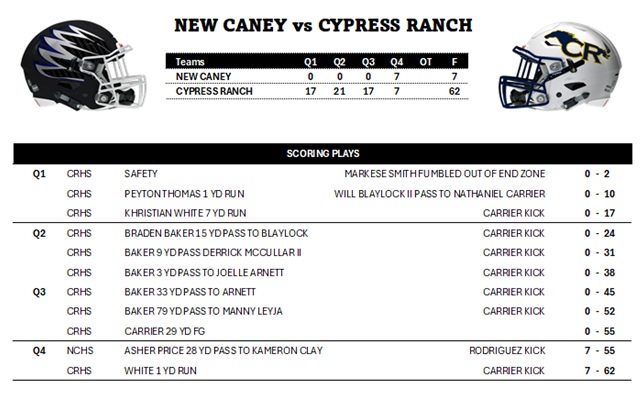
From the first snap, this game had the feel of a mismatch. Cypress Ranch forced a safety just three minutes in, and that early momentum snowballed into a dominant performance. Quarterback Braden Baker was in complete command, completing 12 of 15 passes for more than 400 yards and five touchdowns. His receivers gashed the secondary with explosive plays — four different pass-catchers had gains of at least 40 yards, including a 79-yard strike to Manny Leyja that broke the game wide open.
By halftime, the Mustangs had 38 points and over 300 yards of offense. Running backs Khristian White and Peyton Thomas added short-yardage touchdowns to balance the air attack, and the defense limited New Caney to just 64 yards all night.
For the Eagles, the lone highlight came in the fourth quarter when junior quarterback Asher Price connected with sophomore wideout Kameron Clay for a 28-yard touchdown. It was a crisp throw-and-catch that hinted at the program’s young potential, but it arrived long after the outcome had been decided — and against Cypress Ranch’s second- and third-string defenders.
The context matters here. Head coach Sheldon Bennight shared earlier in the week that his expected senior starter, Grant Webb, suffered an injury in the first preseason scrimmage. That forced the Eagles to turn to sophomore Markeese Smith, who had been projected as their JV quarterback this year, as the varsity starter.
Still a fairly new move-in into the 6A neighborhood (in 2022), limited roster depth has left New Caney relying heavily on underclassmen in one of the toughest 6A districts in Texas — and Thursday’s blowout was a painful reminder of the gap they face.
Friday Night: Langham Creek 54, Jersey Village 3
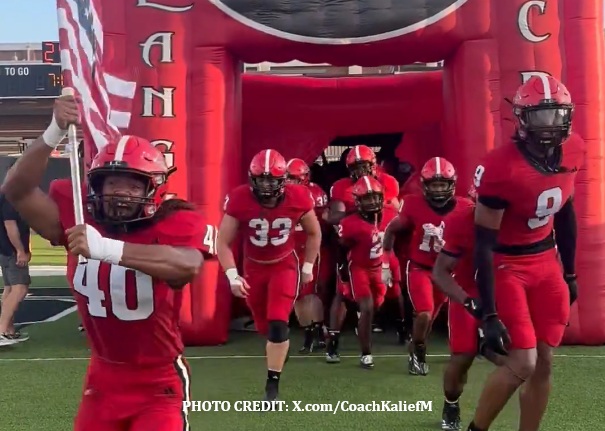
Friday’s blowout felt different. At Pridgeon Stadium, Langham Creek scored early and often, putting up 33 points in the first quarter alone. Running back Jordan King was unstoppable, rushing for 170 yards and four touchdowns on 15 carries. Quarterback Andre Salazar was efficient, going 7-for-9 for 98 yards and two touchdowns before turning things over to backup Jace Williams, who added another 62 yards and two TD passes.
The Lobos piled up 410 total yards of offense (230 rushing, 180 passing) and finished 4-for-4 on fourth down, including two scores. They were balanced, explosive, and opportunistic, capitalizing on short fields created by turnovers and special teams mistakes.
For Jersey Village, the offense never found its rhythm. Starting quarterback Jayden Hudson struggled, and the Falcons turned to Champion Ellis, who finished 9-for-22 for 87 yards. Their best drive came late in the fourth quarter, when they picked up five first downs and salvaged points with a 23-yard field goal on the game’s final play.
In the end, Langham Creek’s depth and playmaking were just too much. The defense limited the Falcons to 165 total yards and forced two turnovers, while the offense spread the wealth — seven different players caught passes, and the Lobos scored touchdowns on the ground and through the air.
But unlike Thursday’s game, this wasn’t about enrollment disparity. Jersey Village has the numbers to compete in 6A. The difference here was cultural and cyclical — Langham Creek seems to be thriving right now, while Jersey Village is in a down period.
Preventable vs. Unpreventable Blowouts
As I watch games each week, I’m always looking for an angle — something that feels worth investigating further, or maybe even searching for a solution if it points to a larger problem.
This past weekend, I couldn’t help but notice something fairly obvious in the two one-sided games I saw. Both were blowouts, but they weren’t the same kind of blowout. One struck me as preventable; the other, not so much.
- Cypress Ranch vs. New Caney showed what happens when the UIL classification system puts a barely-over-the-cutoff school in the same league as powerhouses twice its size. That kind of mismatch is structural, and it can be addressed. A 6A Division II, like 5A already has, would give smaller 6A schools a fairer fight. Raising the 6A floor would also reduce the number of nights where one team is overmatched before kickoff.
- Langham Creek vs. Jersey Village, on the other hand, was about culture and circumstance. Two schools of similar size, same ISD, same resources — yet vastly different results. This isn’t something UIL can legislate away. Some neighborhoods produce football rosters bursting with talent; others see kids drift toward basketball, soccer, baseball, or other interests. Sometimes a coaching staff builds momentum; other times a program is simply in a down cycle.
The Bigger Picture
Blowouts will always exist in high school football. The question is whether they’re preventable mismatches created by system design, or the natural ebb and flow of program strength.
Thursday’s game underscored the danger of throwing small 6A schools like New Caney into the deep end with the state’s giants. Friday’s game reminded us that even when schools are equal on paper, the outcomes on the field will never be uniform.
Maybe that’s the lesson: UIL can and should fix the structural side. But the cultural side — the demographics, the participation patterns, the rhythm of programs rising and falling — that’s part of the beauty and unpredictability of Texas high school football.
A Personal Take on Structural Fixes
I’ve said before that I’m somewhat of a proponent for a Class 7A in Texas, but I’m becoming more amenable to the notion that 6A can remain the highest level — if it’s managed properly. The problem isn’t necessarily that the state needs another classification. The problem is that 6A is the only level not regulated as clearly as the others.
At every classification below 6A, UIL applies Division I and Division II splits at the district level, so schools compete during the regular season against others of similar enrollment. But in 6A, that logic disappears. Smaller schools barely over the cutoff — like New Caney, Caney Creek, and Oak Ridge — are thrown in with giants like The Woodlands or Conroe, and they’re expected to play out full seasons against programs with twice their rosters.
The UIL’s only nod to fairness comes at playoff time, when the top four finishers from each district are divided into Division I and Division II brackets. But that doesn’t solve the problem — it only sorts out the survivors after weeks of lopsided district games. Even then, some of the schools that qualify for the Division II bracket aren’t truly competitive once they step outside their own district.
If UIL made the same decision for 6A that it already does for 5A, 4A, 3A, and 2A — apply the splits at the district level, not just in the postseason — the entire system would instantly be more balanced. That’s a change that wouldn’t require inventing a 7A or overhauling tradition. It would simply bring consistency, fairness, and hope back into Friday nights for the smaller 6A schools that right now are being asked to fight uphill every week.
And if you’re a fan who thinks that uphill battle is no fun to watch, imagine being a kid who suits up every week and has to live it. It’s really no fun for them.
And ultimately, shouldn’t Friday nights be fun?


Leave a comment