
SERIES: THE RAZOR THIN LINE
I didn’t set out to write about a heartbreaking field goal in El Paso.
While researching program histories for a Texas high school football media guide project, I came across a stretch of seasons that felt almost impossible to ignore. From 1975 through 1982, the Eastwood Troopers quietly built one of the most successful runs in school history, compiling a remarkable 60-18-3 record.
Yet that sustained excellence produced only one playoff appearance.
The reason wasn’t a lack of talent. It wasn’t a lack of coaching. It wasn’t even a lack of big-game success.
It was timing. It was structure. It was the razor-thin margins that once defined Texas high school football.
Greatness Without a Stage
Ironically, Eastwood’s lone playoff appearance during that era came in 1977 — arguably one of the least dominant seasons in the run. The Troopers advanced to the postseason only to fall to El Paso Coronado, while stronger Eastwood teams in other years stayed home.
Under the UIL playoff format of the time, only one team from each district advanced. Success was not always measured by how good a team was, but by when it happened to peak.
More than any single game or season, that eight-year stretch became a case study in how greatness can exist without the recognition that usually accompanies it.
A City Anticipates Halloween
If the late 1970s established Eastwood as a contender, Halloween night in 1980 would define how that era would ultimately be remembered.
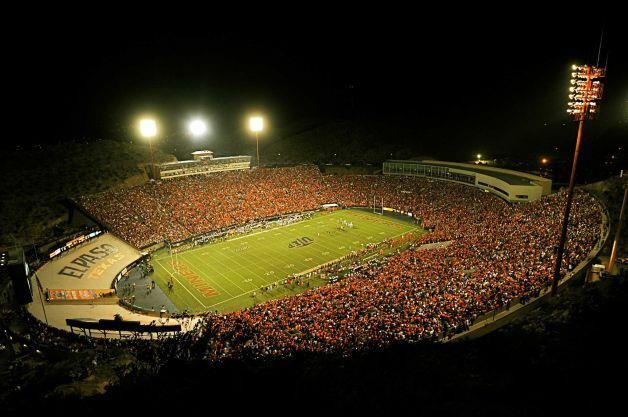
The Troopers faced crosstown rival Bel Air at the Sun Bowl with a district title — and a rare playoff berth — on the line. The stakes were enormous. The atmosphere crackled with anticipation. In football-obsessed El Paso, this was more than a district showdown. It felt like the whole city had shown up to decide a champion.
Halloween fell on a Friday that year — perfectly aligned with the sacred rhythm of Texas high school football. But as both District 2-4A rivals rolled through their schedules unbeaten, anticipation began building weeks in advance. By midseason, conversations across the city had already turned toward the looming showdown.
When Eastwood and Bel Air each opened district play with three straight victories to reach 8-0, excitement spread far beyond the two campuses. Coaches, players, and fans from other El Paso programs openly suggested moving the game to Saturday so the broader football community could attend.
Tradition and routine ultimately prevailed. The game remained under the Friday night lights, leaving many across the city to follow its outcome from afar.
A Defensive Battle for History
What followed lived up to the hype — a tense, grinding defensive struggle that unfolded like a chess match. Yardage came hard. Every first down felt earned.
Eastwood repeatedly pushed into Bel Air territory, winning the battle for field position and holding the critical edge in penetrations inside the 20-yard line — a statistic that, under UIL rules of the time, could determine a district champion if the game ended scoreless.
For nearly four quarters, that possibility seemed real.
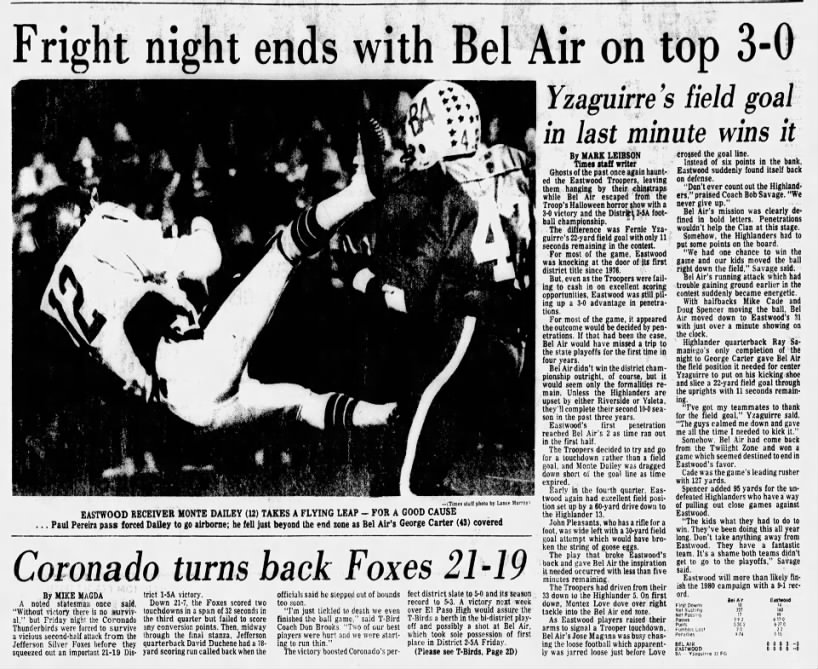
Then, in the final minute, Bel Air pieced together one last drive and lined up for a field goal attempt. The kick sailed through the uprights, breaking the deadlock and stunning the Troopers.
Eastwood’s final possession produced no miracle. When the clock expired, the Highlanders had secured a 3-0 victory — and with it, the district title and playoff berth.
The Season That Slipped Away
For Eastwood, the loss meant the end of a remarkable season. The Troopers closed the year 9-1, dominant in almost every measurable way except the one that mattered most on that night.
There would be no playoff run, no chance at a broader legacy. Instead, their story became one of near-greatness, preserved mainly in local memory and fading newspaper clippings.
The young men who wore Trooper uniforms that evening are now in the later chapters of their lives. Time has undoubtedly softened the sharpest edges of that defeat. Still, moments like that rarely disappear completely. They become part of who we are — reminders that effort and outcome are not always aligned, that success can be fragile, and that disappointment can quietly shape resilience.
Everyone Has Their Own 3-0 Loss
Most people will never play a game with a district title on the line in front of thousands of spectators. But everyone experiences their own version of a 3-0 loss — a missed opportunity, a decision that didn’t go their way, a goal that slipped away at the last moment.
Stories like Eastwood’s do more than preserve football history. They invite reflection on how achievement is measured in the first place.
Every day, people build careers defined by consistency, preparation, and quiet excellence. Teachers shape lives without public applause. Nurses carry the emotional weight of their patients’ struggles. Skilled tradesmen and women keep communities running. Coaches mentor young athletes who may never make headlines. Broadcasters call games in small markets with the same energy and flare of their nationally-known counterparts.
Many of these individuals possess the talent, dedication, and work ethic that could have led to wider recognition. Yet opportunity does not always arrive at the right moment. Systems reward some paths more than others. Timing favors a few. And sometimes the difference between visibility and anonymity is no greater than the bounce of a ball or the swing of circumstance.
But recognition is not the same thing as value.
Life’s Narrow Margins
The Eastwood players who walked off the Sun Bowl field that Halloween night did not become lesser competitors because of a three-point loss. In the same way, people who labor outside the spotlight are not defined by the absence of fame or fortune.
Looking back now, what stands out is not simply one field goal or one missed opportunity. It is the realization that an entire era of Eastwood football — eight seasons of consistency, toughness, and competitive excellence — was shaped by margins so thin they can seem almost cruel in retrospect.
Researching program histories often reveals championship banners and milestone victories. Occasionally, it reveals something just as meaningful: teams whose greatness is measured not by trophies, but by how close they came.
History, in Texas football and in life, is shaped by systems, timing, and razor-thin margins.
In the same way, people who labor outside the spotlight are not defined by the absence of fame or fortune. Their impact is real. Their effort matters. Their legacy often unfolds in ways far more personal — and far more lasting — than public acclaim.
Greatness is not always celebrated. Often, it is simply lived.

Leave a comment